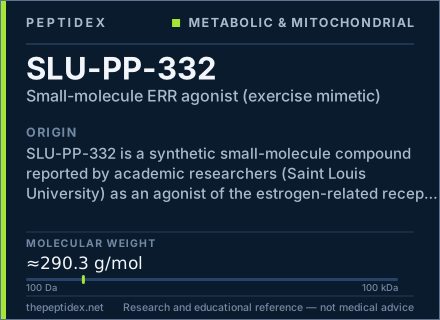
SLU-PP-332
Small-molecule ERR agonist (exercise mimetic)
An ERR (estrogen-related receptor) agonist and exercise-mimetic compound referenced in metabolic research.
Also referenced as: SLU-PP-322, Exercise mimetic
Overview
SLU-PP-332 is a synthetic small-molecule compound reported by academic researchers (Saint Louis University) as an agonist of the estrogen-related receptors (ERRs). It is not a peptide. It has been studied as a candidate exercise-mimetic research compound.
At a glance
What SLU-PP-332 does
SLU-PP-332 is a synthetic small-molecule agonist of the estrogen-related receptors (ERRs), a family of orphan nuclear receptors, developed at Saint Louis University. It activates all three isoforms (ERR-alpha, ERR-beta, ERR-gamma) with preferential potency at ERR-alpha. This matters because ERR-alpha and ERR-gamma are the transcription factors that, working with the coactivator PGC-1alpha, drive the gene programs for mitochondrial biogenesis, fatty-acid oxidation, and the Krebs (TCA) cycle. By directly agonizing these receptors, SLU-PP-332 switches on the oxidative-metabolism transcriptional signature that endurance exercise normally induces, which is why it is described as an exercise mimetic that works at the level of gene expression rather than by stimulating adrenergic fat burning or activating AMPK upstream.
In preclinical studies, SLU-PP-332 reproduced an ERR-alpha-dependent exercise gene signature in sedentary mice, and this translated to functional adaptations: improved running endurance, increased skeletal-muscle oxidative capacity and mitochondrial markers, and greater energy expenditure. Reported metabolic effects in obese mouse models include reduced weight gain and improved metabolic parameters, consistent with a shift toward fat oxidation. It is important to be clear about the evidence state: all efficacy data come from rodents. As of 2026 SLU-PP-332 is a research tool compound with no FDA approval and no human clinical trial program, so nothing about its effects has been demonstrated in people.
Effects reported in research
- Agonizes estrogen-related receptors (pan-ERR, preferentially ERR-alpha), the core mechanism.
- Activates the ERR/PGC-1alpha transcriptional program for mitochondrial biogenesis (animal/cell data).
- Induced an ERR-alpha-dependent 'exercise gene signature' in sedentary mice without training.
- Increased skeletal-muscle oxidative capacity and mitochondrial markers in mice.
- Improved running endurance in untrained mice (functional exercise-mimetic effect, animal only).
- Upregulated fatty-acid oxidation and Krebs-cycle gene expression, raising energy expenditure (preclinical).
- Reduced weight gain and improved metabolic parameters in obese mouse models.
- No human data of any kind — research tool compound, not FDA-approved, no clinical trials as of 2026.
Effects listed reflect findings reported in the research literature — many in animal or in-vitro models. Listing an effect is not a claim of efficacy or a therapeutic indication in humans.
Mechanism of action
SLU-PP-332 is reported to act as a pan-agonist of the estrogen-related receptors (ERRalpha, ERRbeta, ERRgamma), nuclear receptors that regulate mitochondrial biogenesis, oxidative metabolism, and energy expenditure. In preclinical models, ERR activation has been associated with increased mitochondrial activity, fatty-acid oxidation, and endurance-type metabolic adaptations, prompting its description as an exercise mimetic.
Mechanistic description reflects published research-literature understanding. Much peptide research is preclinical (in-vitro or animal-model); mechanism in humans may differ and is not established for many compounds.
What it's studied for
Research contexts in which SLU-PP-332 appears in the literature. Listing a research area is not a claim of efficacy or a therapeutic indication.
Key characteristics
- A small molecule, NOT a peptide
- Acts as an agonist of estrogen-related receptors (ERRs)
- Investigated as an exercise-mimetic in preclinical models
- Rationale centers on driving mitochondrial and oxidative metabolism
- Early-stage research compound with no approved human use
Reported research dosing reference only
Educational reference, not dosing guidance. The figures below summarize amounts reported in published research and research-community protocols, provided for educational and research context only. They are not medical advice, not a recommendation, and not instructions for human use. SLU-PP-332 is a research compound.
Reported research dosing derives from rodent studies rather than established human protocols. Published mouse metabolic work used systemic (injectable) dosing. These are figures reported for research context only, not dosing guidance for humans.
- Rodent metabolic studies: commonly referenced around ~50 mg/kg, dosed intraperitoneally (twice daily in some protocols)
- Human protocol dosing is not established in the literature
Small molecule (ERR agonist), not a lyophilized peptide. Human dosing is not established; all figures are research reference only.
How it compares
Unlike the peptides here, SLU-PP-332 is a nuclear-receptor-targeting small molecule; unlike AICAR (which activates AMPK), it works upstream at the ERR transcription-factor level.
Commonly studied alongside
Compounds frequently researched together with SLU-PP-332 in the literature. Cross-referenced for research context — not a usage or combination recommendation.
Compare and calculate
Side-by-side pages for the pairings the literature already documents for SLU-PP-332, plus the unit-conversion reference for a reconstituted vial. Factual comparisons of documented characteristics — not a recommendation to combine or use any compound.
Handling & Stability
Storage and handling depend on the supplied form, which varies for this compound. Follow the supplier’s stated conditions and shelf life.
- Avoid repeated freeze-thaw cycles
- Verify supplier lot and Certificate of Analysis
- Follow institutional lab-safety protocols
Analytical & COA Concepts
Reputable research suppliers publish a third-party Certificate of Analysis per batch. Key analytical concepts referenced in COAs include:
Category Context
SLU-PP-332 sits in the Metabolic & Mitochondrial area of the PeptiDex library.
- Entry type: Research compound reference
- Metabolic & Mitochondrial category hub →
- Browse the full library →
- Glossary of terms →
Where researchers source SLU-PP-332
For researchers studying SLU-PP-332, third-party suppliers such as Practically Natty Peptides offer research-grade material with third-party Certificates of Analysis and US-based shipping.
View research-supplier listing →
Outbound link to a third-party research supplier. Inclusion does not constitute endorsement; all editorial content is developed independently.
Frequently asked questions
Is the catalog name 'SLU-PP-322' correct?
The correct compound name is SLU-PP-332 (the '322' spelling is a common transposition error). SLU-PP-332 is a synthetic pan-ERR (estrogen-related receptor) agonist studied as an exercise-mimetic and metabolic compound. All information here refers to SLU-PP-332.
Is SLU-PP-332 a peptide?
No. SLU-PP-332 is a small molecule, not a peptide. Its molecular formula is C18H14N2O2 (MW ~290.3, CAS 303760-60-3), and it has no amino-acid sequence. It is grouped with metabolic peptides in catalogs because of its fat-oxidation/exercise-mimetic research context.
What is the mechanism of SLU-PP-332?
SLU-PP-332 is a pan-agonist of the estrogen-related receptors, with reported EC50 values around 98 nM (ERRalpha), 230 nM (ERRbeta), and 430 nM (ERRgamma), i.e. most potent at ERRalpha. Activating ERRalpha upregulates PGC-1alpha, driving mitochondrial biogenesis and fatty-acid oxidation, which is why it is described as an exercise mimetic.
What is SLU-PP-332 studied for?
It is studied in preclinical models of metabolism and exercise physiology, where administration mimicked exercise-induced increases in energy expenditure and fatty-acid oxidation and reduced fat-mass accumulation in mice. Related ERR-agonist work has also examined cardiac fatty-acid metabolism and heart failure. Findings are preclinical.
Why is SLU-PP-332 flagged for doping potential?
Because it pharmacologically mimics endurance-exercise adaptations via ERR/PGC-1alpha signaling, SLU-PP-332 (and analogs like SLU-PP-915) have been characterized in anti-doping metabolism studies, which identified multiple phase-I and phase-II metabolites. This reflects its exercise-mimetic profile rather than any approved use.
Answers are educational summaries of research-literature context and do not constitute medical advice. See the Research Library, COA guide, and Storage & Handling guide for more.
References
Primary literature indexed in PubMed for SLU-PP-332. Listing a study records that it exists and is indexed — it is not a claim of efficacy, a therapeutic indication, or an endorsement of its conclusions. Much of this literature is preclinical (in-vitro or animal-model).
- Synthetic ERRα/β/γ Agonist Induces an ERRα-Dependent Acute Aerobic Exercise Response and Enhances Exercise Capacity
- A Synthetic ERR Agonist Alleviates Metabolic Syndrome
Each reference was checked against its PubMed record on 2026-07-28: the PMID resolves and the title, journal and year match. Where no indexed literature exists for a compound, PeptiDex says so rather than substituting a citation about a different molecule. See the editorial policy.